 Models
 Materials
 HDRIs
 Scenes
 Brushes
 Node Groups
 Printables
 Creators
 Creations
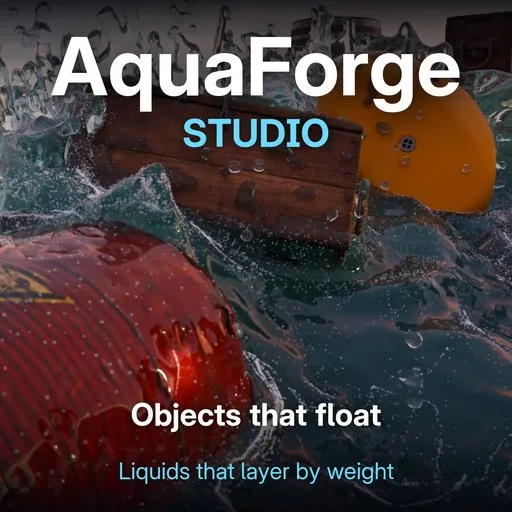
AquaForge Studio: Floating Objects & Multi-Fluid Liquid Simulation
 add-on
GPU liquid simulation for Blender with objects that float and liquids that layer by weight: everything in AquaForge Pro, plus buoyancy, multi-fluid and resolution up to 1024.
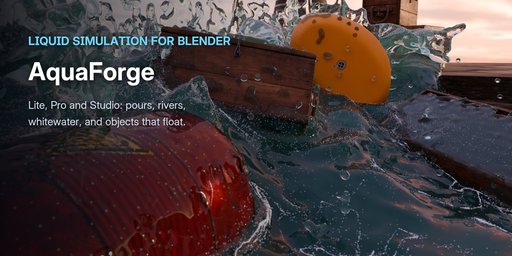
Liquid Simulation for Blender
AquaForge Studio is the full AquaForge: pour juice into a glass, run a river through a landscape, throw a surge at floating crates.
Bakes on your graphics card, about 14× faster than on the CPU, and renders in Cycles or EEVEE.
Every clip on this page is a real AquaForge bake.
Objects That Float
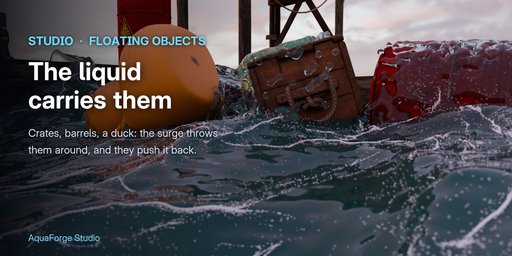
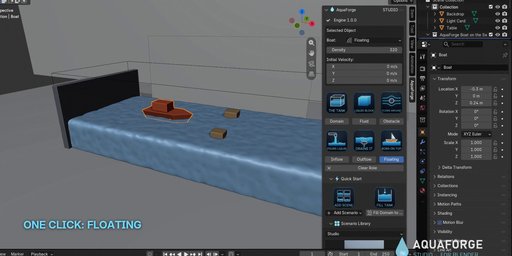
Give a mesh the Floating role and press Bake.
The liquid lifts, rocks and carries it, and it pushes the liquid back. Crates thrown together by a wave bump and turn instead of passing through.
No keyframes: the bake moves the object, and Free Bake puts it back.
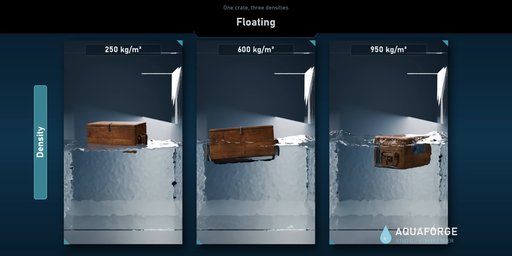
Density Sets How It Floats
Light objects ride high, heavy ones hang low.
Water is 1000 kg/m³, wood about 500–700, a boat or a rubber duck about 200–400.
Floating objects collide with obstacles and with each other.
Liquids That Layer by Weight
Every Fluid and Inflow can hold its own liquid.
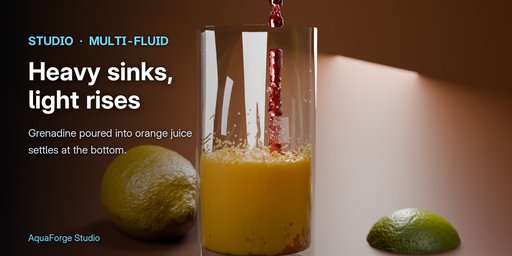
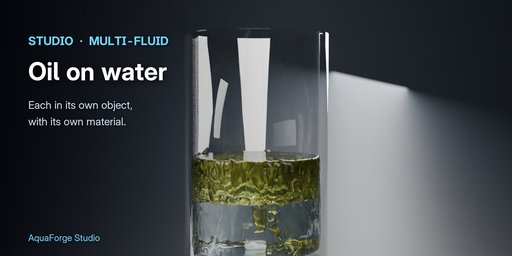
Lighter liquids rise and heavier ones sink: grenadine and honey go to the bottom of the glass, oil settles on water.
Each liquid gets its own object and material, ready to shade.
Resolution up to 1024
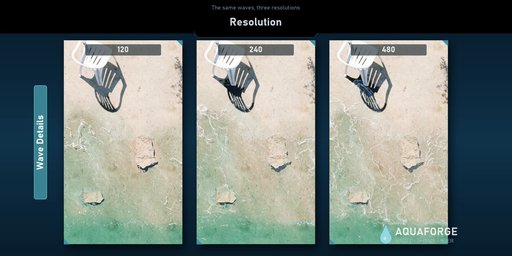
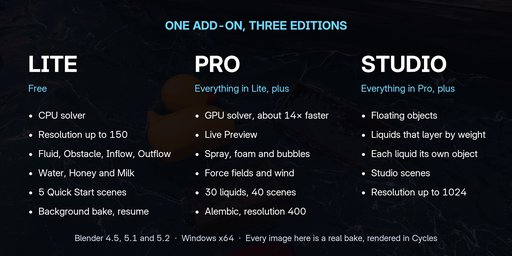
Bigger water, finer waves: Pro goes up to 400, Studio to 1024.
The bake estimate shows particles, memory, disk and time before you bake.
Bakes on the GPU
The same bake: 0:28 on the GPU, about 6½ minutes on the CPU.
NVIDIA, AMD and Intel through OpenCL, with nothing extra to install. Every feature runs on it.
No usable GPU? It bakes on the CPU by itself.
Live Preview
See the simulation before you bake it.
It runs at low resolution in the viewport as you watch: move an obstacle, change a setting, look again.
Happy with it? Bake the real thing.
Whitewater
Spray, foam and bubbles, baked with the liquid.
Born where the liquid is fast, churning or cresting: foam rides the surface, spray flies, bubbles rise.
Separate sizes and materials for each kind: change the look without baking again.
Force Fields and Viscosity
Shape the liquid with Blender's own force fields: Force, Vortex, Turbulence and Wind.
Viscosity from water to thick chocolate, stable at any thickness.
Surface tension for drops and small-scale liquid.
Water and Honey, One Bake
Give any Fluid or Inflow its own viscosity.
Water runs and honey slumps, side by side in the same bake.
Coloured here by the surface's viscosity attribute.
Shade It by Speed
The surface carries the liquid's speed and velocity, its vorticity and its age.
Read them with an Attribute node in any material, or in Geometry Nodes.
Here: slow water deep blue, the fastest splash orange.
Survives a Crash
Blender stays usable while it bakes: the panel shows the frame, the speed and the time left.
Blender crashed, or the power went out? Open the file and press Resume.
The bake carries on from the last finished frame.
30 Liquids, 40 Scenes
Start from a look and a setup that already work.
Liquid presets: water, coffee, wine, beer, honey, chocolate, lava, liquid gold and more.
Ready-made scenes: beer pour, crown splash, boat wake, whirlpool, waterfall, river over rocks. Plus the Studio scenes: Boat on the Swell, Oil on Water and Crates into a Pool.
Learn It in Minutes
ALSO IN STUDIO
• Everything in AquaForge Pro: the GPU solver, Live Preview, whitewater, force fields, surface tension, the 30 liquids and the 40 scenes.
• Liquids stirred together separate again as they settle. Each one shows in its own object (AquaForge Olive Oil, AquaForge Honey…), ready to shade like any other.
• Fluid from any closed mesh, static and moving obstacles, keyframable inflows and outflows.
• Volume correction keeps the liquid's volume over long bakes.
• Motion blur: the surface carries the liquid's velocity, so Cycles blurs splashes the way they move.
• Export Alembic: the surface (with velocity) and the whitewater, every frame.
• Clear messages: a mesh with holes is named and refused instead of baking wrong.
MORE VIDEO
The basics (tank, roles, bake, whitewater, rendering): https://www.youtube.com/watch?v=YFXHhM9p8Rs
INSTALL
Edit › Preferences › Get Extensions › Install from Disk, and pick the zip. If AquaForge Lite or Pro is installed, disable it, so there's one AquaForge tab. Scenes made in Lite or Pro open in Studio as they are.
REQUIREMENTS
• Blender 4.5, 5.1 or 5.2
• Windows 64-bit (macOS and Linux builds are planned)
• A multi-core CPU; for GPU baking, a graphics card with OpenCL 1.2 (any recent NVIDIA, AMD or Intel GPU) and enough video memory for the bake. High resolutions need a lot of memory: check the bake estimate first.
GOOD TO KNOW
• Fluids, obstacles, inflows, outflows and floating objects must be closed meshes; walls thinner than about two grid cells can let liquid (or a fast floating object) through.
• Make a floating object as one closed shape: a boat with its cabin joined to the hull, not separate parts.
• Force fields accelerate the liquid for as long as they act: small strengths go a long way.
• Surface tension shows at small scale; in a bathtub-sized scene it does almost nothing.
• Try it first: AquaForge Lite is free on Blendkit.
LICENSE
GPL-3.0-or-later.


