 Models
 Materials
 HDRIs
 Scenes
 Brushes
 Node Groups
 Printables
 Creators
 Creations
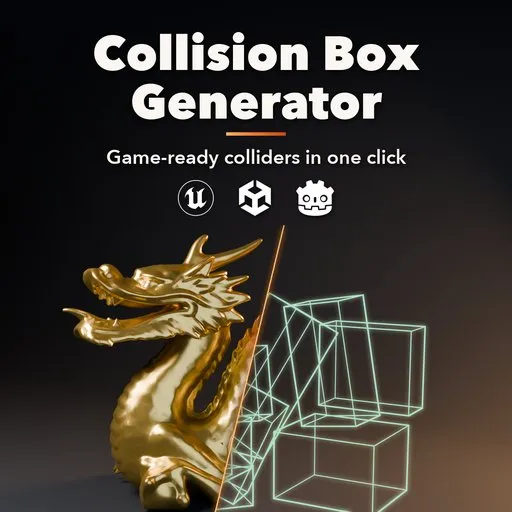
Collision Box Generator - Game Colliders for Unreal, Unity and Godot
 add-on
One-click game colliders: fits box, sphere, capsule and convex hull colliders to any mesh, named and exported for Unreal (UCX), Unity and Godot.
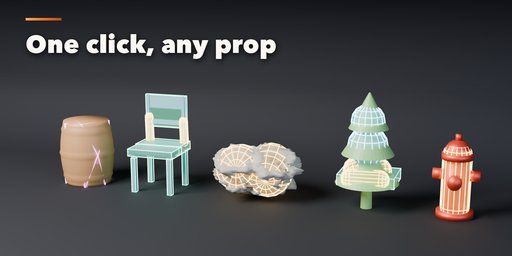
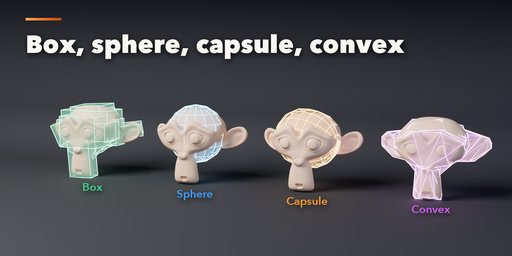
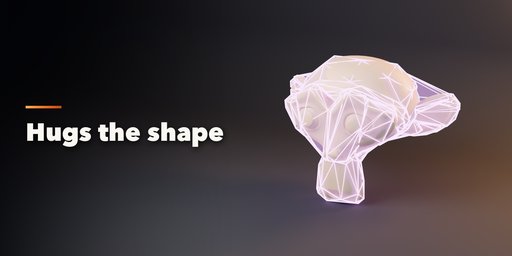
Collision Box Generator wraps any mesh in game-ready colliders with one click. Select a model, press Generate Colliders, and the addon fits a small set of boxes, spheres, capsules or convex hulls that follow its shape, named exactly the way your game engine expects. No more hand-placing UCX cubes for every prop.
The solver voxelizes the model, splits it into parts and fits the best simple shape to each part, then tightens every collider against the real surface. A typical prop gets six to twenty colliders in about a second, covering more than ninety percent of the model while barely sticking out.
Features
- One click: select one or many meshes and press Generate Colliders
- Five shape modes: Auto (picks the best shape per part), Box, Sphere, Capsule and Convex
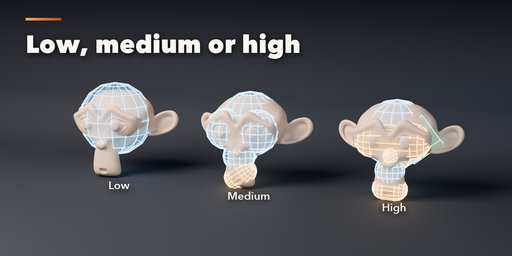
- Low, Medium and High detail, plus an exact collider limit, tightness, seed and hull vertex limit
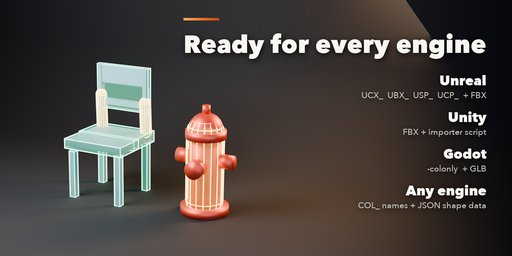
- Unreal: UCX_, UBX_, USP_ and UCP_ names, exported with the model as FBX
- Unity: FBX plus an importer script that turns colliders into real Box, Sphere, Capsule and Mesh colliders
- Godot: -colonly names exported as GLB
- Any other engine: COL_ names plus JSON with the exact position, rotation and size of every collider
- Result card with collider count, coverage and how far colliders stick out; Select, Hide and Clear in one click
- Colliders are parented to the model, drawn as colored wireframes and never show up in renders
- Pure Python and numpy, no external libraries or downloads
How it works
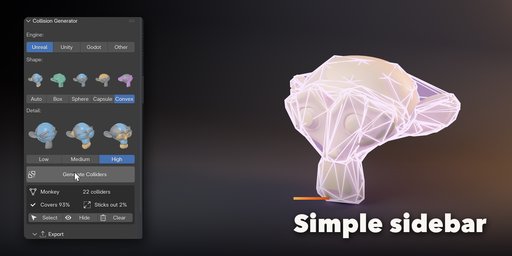
- Open the Collision tab in the 3D viewport sidebar
- Pick your engine, a shape and a detail level from the picture tiles
- Press Generate Colliders, then Export
Requires Blender 4.2 or newer. Tested on Blender 4.2, 4.5 and 5.2 LTS.
How to use
Installation
In Blender open Edit, Preferences, Get Extensions, then use Install from Disk and pick the collision_generator zip.
Usage
- Open the Collision tab in the 3D viewport sidebar (N).
- Pick your engine: Unreal, Unity, Godot or Other. Collider names follow the engine (UCX_/UBX_/USP_/UCP_ for Unreal and Unity, -colonly for Godot, COL_ for Other).
- Pick a shape (Auto, Box, Sphere, Capsule or Convex) and a detail level (Low, Medium, High).
- Select one or more meshes and press Generate Colliders. The result card shows the collider count, how much of the model they cover and how far they stick out, with Select, Hide and Clear buttons.
- In Export choose a folder and press Export: FBX for Unreal and Unity (with an optional Unity importer script), GLB for Godot, and an optional JSON file with the exact shapes.
- Advanced holds the collider limit, tightness, seed, hull vertex limit and how colliders are drawn.
Colliders are parented to their model and hidden from renders.
FAQ
Which Blender versions are supported?
Blender 4.2 and newer. It is tested on Blender 4.2, 4.5 and 5.2 LTS.
Which game engines does it support?
Unreal Engine (UCX_, UBX_, USP_, UCP_ colliders in FBX), Unity (FBX plus an importer script that creates Box, Sphere, Capsule and Mesh colliders), Godot (-colonly in GLB) and any other engine through COL_ names and a JSON file.
Does it work on high-poly models?
Yes. The solver works on a voxel version of the model, so a 60,000 triangle model gets its colliders in one to four seconds depending on the detail level.
Do I need to install anything else?
No. It runs on Blender's own Python and numpy, with no external libraries or downloads.


