 Models
 Materials
 HDRIs
HDRIs
 Scenes
 Brushes
 Node Groups
 Printables
 Creators
 Creations
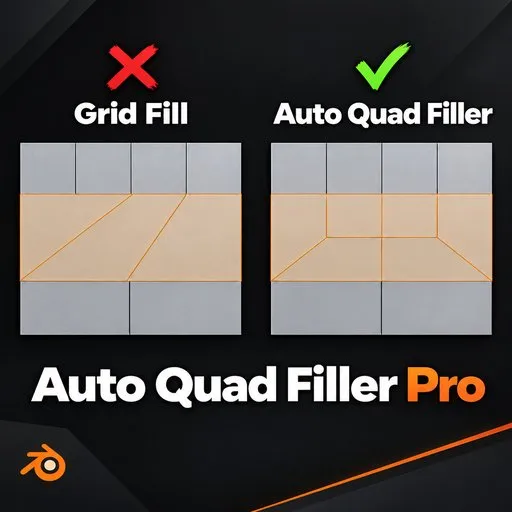
Auto Quad Filler Pro – One-Click Quad Topology Transitions Between Uneven Edge Loops
 add-on
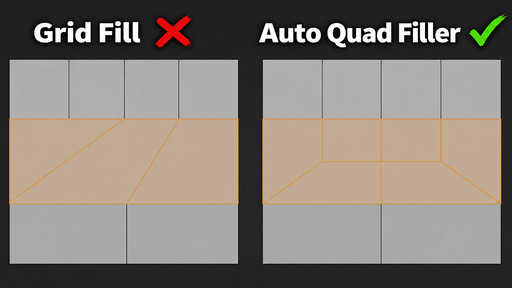
Auto Quad Filler Pro closes the gap between two edge loops with different edge counts using clean, all-quad topology instead of the long diagonal triangles you get from Grid Fill or manual bridging. Select two open edge chains
The problem: merging uneven edge loops always ends in bad topology
Every Blender modeler hits this wall. You have four edge loops on one side of a surface and only two on the other. Maybe it's a character's torso narrowing into an arm, a hard-surface panel stepping down, or two separately modeled parts that need to join. Blender's Grid Fill and manual Bridge Edge Loops can technically close that gap, but they do it with long diagonal edges cutting across the surface. Those diagonals turn into stretched triangles or n-gons the moment you subdivide, and they break your edge flow.
The usual fix is manual: place a pole, cut in extra edges by hand, merge vertices, clean up triangles, check the normals, and hope the flow still reads correctly after a Subdivision Surface modifier. On a simple panel that's a few minutes. Repeated across a whole character or hard-surface kit, it is hours of repetitive, error-prone work.
What Auto Quad Filler Pro actually does
Auto Quad Filler Pro is a Blender add-on that automates exactly this step. In Edit Mode, select two separate open edge chains with a different number of edges — for example a 4-edge loop and a 1-edge loop — and run the Fill operator. The add-on builds a proper quad-first topology transition between them, using the same reference-style pole patterns experienced topology artists use by hand: three or four quads feeding into one lower support face, instead of one giant fan of triangles.
It is not a general remesher and it does not touch the rest of your mesh. It only replaces the exact gap between your two selected chains. Your original boundary edges are never moved, split, or deleted — the add-on works on a temporary copy of the mesh and only commits the result if the entire transition passes validation.
How it fits your workflow
Select two open boundary edge chains in Edit Mode (the two loop ends you want connected).
Check the N-panel: it reads your selection live and shows the exact ratio, e.g. "Ready: 4 → 1".
Press Shift+F, click Fill, or right-click and choose Quad Filler from the context menu.
The transition is generated, selected, and ready for further editing or a Subdivision Surface modifier.
If the two chains have different edge-count parity (an odd difference, like 5 → 2), the add-on adds a single supporting vertex on one side automatically so the result still closes as clean quads — you do not have to work out the parity fix yourself.
Built for predictable, subdivision-ready results
Every supported ratio has a known, fixed face breakdown, so you always know what you are getting:
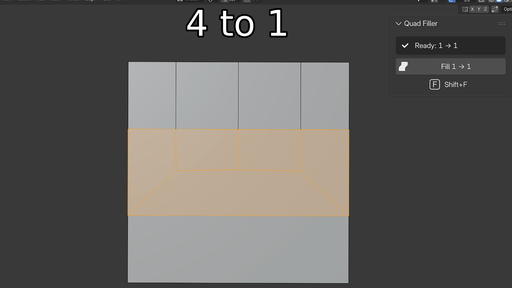
4 → 1: 4 quads + 1 five-sided face
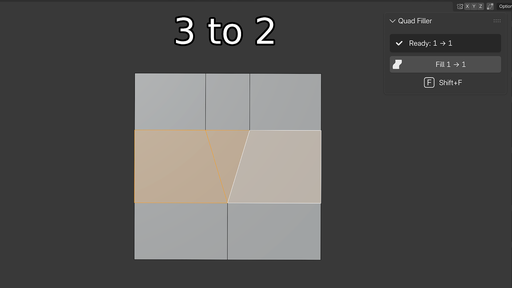
3 → 2: 2 quads + 1 triangle
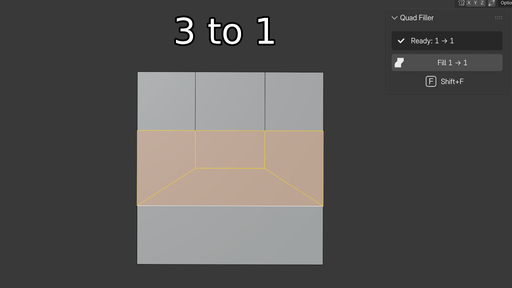
3 → 1: 4 quads
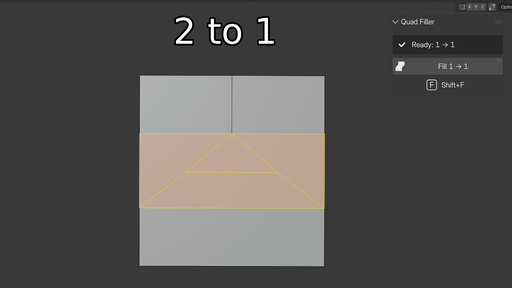
2 → 1: 3 quads + 1 triangle
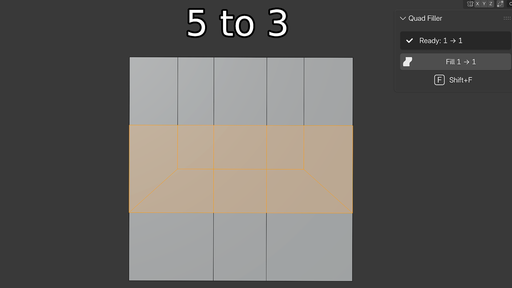
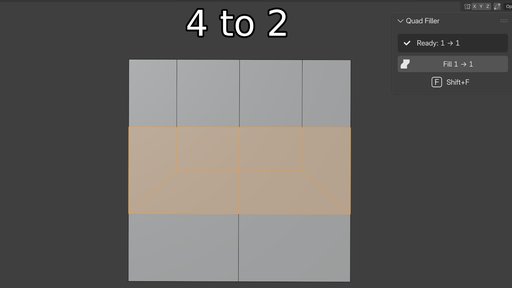
Larger and uneven ratios (5 → 3, 6 → 2, 4 → 2, and so on) are handled by the same strip-reduction logic, splitting the difference into individual two-strip reduction points along the loop instead of one wide fan.
Every generated patch is checked against its expected quad/triangle/n-gon count before it is written to your mesh. If a candidate does not validate, the add-on rejects it and leaves your mesh exactly as it was — you get a clear error message in the status bar instead of a broken result to clean up.
Options that respect your original geometry
Preserve Symmetry — on mirrored parts (like a symmetrical character or prop), the add-on favors placing the transition so both sides land in matching positions.
Relax Internal Vertices — smooths the newly created internal points for a nicer surface flow without ever moving your selected boundary vertices.
Debug Mode — highlights the generated transition faces with a dedicated debug material and writes the full candidate scoring breakdown to a text block, useful when you want to see exactly why a particular layout was chosen.
Who this is for
Character and creature modelers building clean, subdivision-ready quad topology for rigging and deformation.
Hard-surface and game asset artists closing loop-count mismatches on panels, greebles, and mechanical parts.
Retopology artists merging loop counts from different parts of a base mesh.
Anyone tired of manually placing poles and cleaning up Grid Fill triangles every time two edge loops do not match.
Why it beats the manual workflow
Grid Fill gives you a flat fan of diagonal edges across the whole gap — one operation, one topology shape, no options. Auto Quad Filler Pro instead builds the transition the way a topology-aware artist would place it by hand: quads on the outside, a controlled pole or small n-gon only where the math requires it, and a supporting horizontal edge that keeps the surface reading correctly under subdivision. What used to take manual edge cuts, vertex merges, and cleanup now takes one selection and one keypress — and it is undo-safe, because nothing is committed until the result passes validation.
Key Features (with benefits)
- One-click quad transitions (Shift+F or Fill button) — turns a multi-minute manual topology fix into a single keypress, so you spend time modeling instead of patching edge flow.
- Template-based reference topology (4→1, 3→2, 3→1, 2→1, and general reduction bands) — every transition follows a known, artist-style pole pattern instead of a random triangle fan, so your result looks intentional, not accidental.
- Automatic parity handling — odd-count differences get a single side vertex added automatically, so you never have to work out the extra-edge fix by hand.
- Live selection readout in the N-panel — shows "Ready: X → Y" before you even click, so you know exactly what transition will be built and catch selection mistakes early.
- Validated, undo-safe commits — the add-on plans and checks the entire result on a working copy first; if anything fails validation, your original mesh is left untouched and you get a clear error message.
- Preserve Symmetry option — keeps transitions mirrored correctly on symmetrical meshes, saving you from manually matching left/right topology.
- Relax Internal Vertices option — smooths new interior points for better shading and subdivision behavior without moving your original boundary.
- Debug Mode with visual highlighting — colors the transition faces and logs the full candidate comparison, so you can understand or troubleshoot exactly what was generated and why.
- Right-click context menu and dedicated N-panel tab — fits directly into the Edit Mode workflow you already use, no extra menus to hunt for.
- Non-destructive to your selection — your originally selected boundary edges are never split, merged, or moved by the operation.
Workflow Benefits
Cuts topology cleanup time from minutes to seconds on every loop-count mismatch you hit while modeling.
Keeps edge flow consistent across a model instead of leaving stretched triangles that show up as pinching or shading artifacts after a Subdivision Surface modifier.
Removes the guesswork of manual pole placement — the add-on already knows where the pole or n-gon should sit for each ratio.
Reduces retopology errors because every result is validated against an expected face count before it touches your mesh.
Speeds up iteration — since it is a normal Blender operator with full undo support, you can try a fill, undo, adjust your selection, and try again without any risk to your mesh.
Fits existing habits — works from a selection and a keyboard shortcut, so it slots into a normal box-modeling or retopology pass without changing how you already work.
Use Cases
- Character modeling: closing the loop-count gap where a torso, limb, or neck narrows and the surrounding loops don't line up 1-to-1.
- Hard-surface and mechanical modeling: merging panel sections, greebles, or plating where one side has more loop cuts than the other.
- Game asset creation: producing clean, subdivision- and normal-map-friendly quad topology for assets that need to bake or deform correctly.
- Retopology over a sculpt or scan: joining retopologized sections that were built at different edge densities.
- Prop and hard-surface kitbashing: connecting two separately modeled pieces whose edge loops don't naturally match.
- Teaching and topology reference: quickly generating textbook examples of 4-to-1, 3-to-2, 3-to-1, and 2-to-1 pole transitions for study or demonstration.


