 Add-ons
 Models
 Materials
 HDRIs
HDRIs
 Scenes
 Brushes
 Node Groups
 Printables
 Creators
 Creations
What's New in Version 1.1.0
Version 1.1.0 updates the preset library, generator workflow, color handling, image sampling, and conversion cleanup.
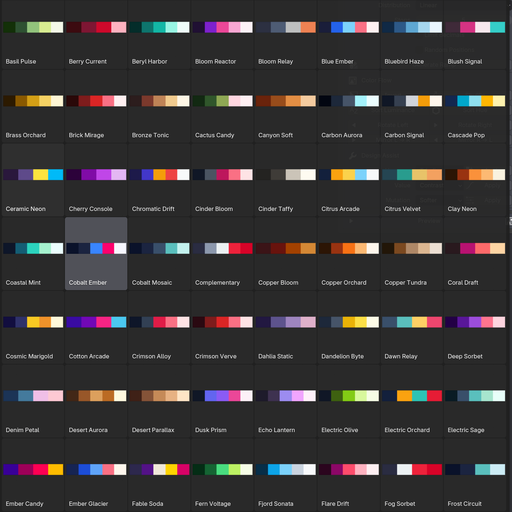
- 162 active curated presets with broader variation and fewer near-duplicates.
- Preset search plus category and color-family filters.
- A Grayscale category with black, white, gray, charcoal, silver, and multi-stop value ramps.
- A new Generate choice for Color Sampler or Preset.
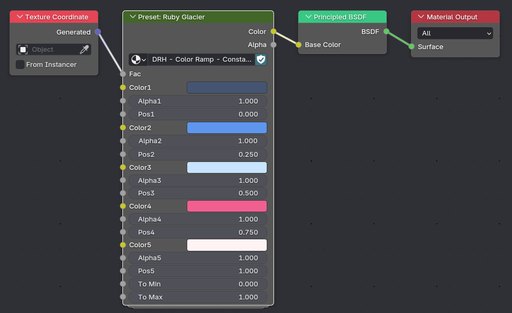
- Preset mode creates a default Color Ramp first and applies the selected preset only when you click Generate Ramp.
- New ramps are placed in the visible Node Editor area instead of at an old cursor position.
- Image palette extraction uses bounded sampling and add-on-owned temporary image data.
- Color operations use a clearer sRGB-to-linear workflow for preset, image, sampled, and HSV-style edits.
Why DRH - Color Ramp Studio
Build, sample, refine, and reuse Blender Color Ramps without rebuilding every gradient by hand.
DRH - Color Ramp Studio combines 162 curated presets, image and screen sampling, palette generation, conversion and restore tools, grayscale ramps, alpha controls, and precision editing in one Node Editor workflow.
Use it in Shader, Geometry Nodes, and Compositor work when you want to move from a reference or color idea to a usable Color Ramp with fewer repetitive steps.
Free for everyone on BlendKit.
Key Features
- 162 curated Color Ramp presets for fast starting points.
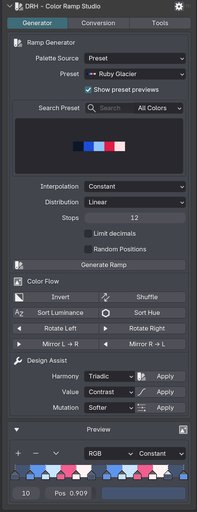
- Preset browser with text search, category filtering, and color-family filtering.
- Palette categories: Trending, Pastel, Dark, Vibrant, Earthy, Warm, Cool, Neutral, and Grayscale.
- Multiple palette sources: Preset, Complementary, Analogous, Random, Grayscale, Stripes, and Image.
- Color Sampler for turning on-screen references into editable Blender Color Ramps.
- Image palette extraction from selected reference files.
- Native ramp conversion into editable node-group setups.
- Restore workflow for returning converted groups to native Color Ramps.
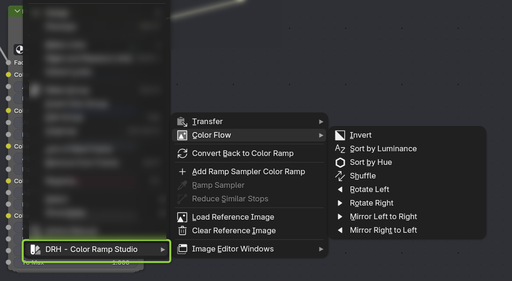
- Color-flow tools including invert, shuffle, rotate, mirror, hue sorting, luminance sorting, and palette variation.
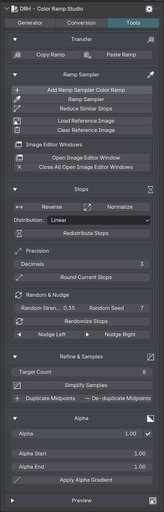
- Stop editing tools including redistribution, normalization, reverse, randomization, simplification, duplication, merging, and precision controls.
- Alpha tools for uniform alpha and alpha gradients.
- Multiple interpolation workflows with Blender Color Ramp interpolation support.
- Support for Shader Editor, Geometry Nodes, and Compositor workflows.
Presets and Palette Generation
The preset browser includes text search, category filtering, and color-family filtering.
Version 1.1.0 contains 162 active presets and 31 compatibility aliases. The library was reworked to reduce visually similar palettes, especially repeated warm copper, orange, and pale-cream combinations.
Categories include:
- Trending
- Pastel
- Dark
- Vibrant
- Earthy
- Warm
- Cool
- Neutral
- Grayscale
You can also generate ramps from complementary or analogous colors, random palettes, grayscale values, stripes, or an image file.
Color Sampler and Image Palettes
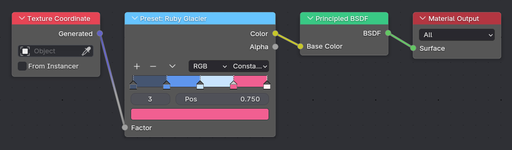
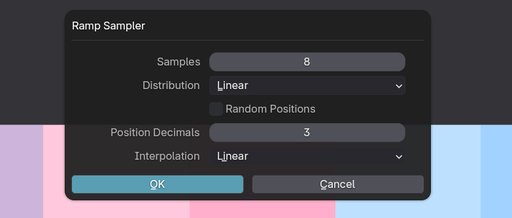
Color Sampler turns a visual reference into editable Color Ramp stops.
Create a sampler ramp, choose the sampling settings, then draw across the reference. The sampled colors are written into the active ramp so you can continue editing them in Blender.
This is useful for matching:
- Concept art
- Photographs
- Screenshots
- Painted references
- Existing graphics
- UI references
- Color studies
Image palette extraction provides a second reference workflow. Choose an image file and generate a palette from sampled image colors without copying the complete pixel buffer into a Python list.
Generate the Ramp You Need
The Generate button asks which workflow you want to start.
Color Sampler
Creates a native Color Ramp and immediately opens the sampling workflow.
Preset
Creates a default native Color Ramp without applying preset colors.
Choose or browse a preset in the N Panel, then click Generate Ramp when you are ready to apply it.
New ramps are placed inside the visible Node Editor area instead of using the stored node-cursor position, which helps prevent nodes from appearing behind the N Panel.
Convert, Edit, and Restore
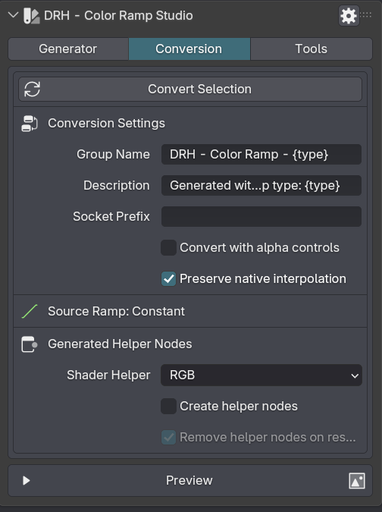
Convert native Color Ramp nodes into editable node-group setups when you need more control over the ramp structure.
The add-on stores restore data so the result can be returned to a native Color Ramp when needed.
This makes it easier to:
- Experiment with ramp behavior
- Expose values through node groups
- Integrate ramps into larger procedural systems
- Build reusable shader controls
- Return to Blender's native Color Ramp workflow later
Version 1.1.0 also improves cleanup for incomplete conversions and generated node groups.
Ramp Editing Tools
Color Ramp Studio includes tools for both stop positions and colors.
Stop tools include:
- Redistribute
- Normalize
- Reverse
- Randomize
- Simplify
- Duplicate midpoint stops
- Merge similar neighboring stops
- Nudge positions
- Limit stop precision
Color tools include:
- Invert
- Shuffle
- Rotate
- Mirror
- Sort by hue
- Sort by luminance
- Value adjustment
- Harmony generation
- Palette variation
Alpha controls let you apply a uniform alpha value or build an alpha gradient across the ramp.
Better Image and Color Handling
Preset hex colors, sampled colors, and image-derived colors use an explicit sRGB-to-linear workflow before they are stored in Blender ramps.
Hue and saturation style edits are handled in a display-oriented color space and converted back for Blender.
Image palette extraction uses bounded sampling instead of copying the complete image pixel buffer into Python.
Temporary image data created by the add-on is tracked separately so unrelated user image datablocks are left untouched.
Perfect For
- Shader development
- Look development
- Procedural materials
- Geometry Nodes
- Compositing
- Gradient matching
- Palette exploration
- Reference-based color work
- Stylized materials
- Masks and value ramps
- Color variation workflows
- Image-derived palettes
- Technical Color Ramp editing
Free on BlendKit
DRH - Color Ramp Studio is free for everyone on BlendKit.
Download the current official release directly from this page.
Try it in your workflow and leave a rating to support new features and updates!
GitHub is used for:
- Documentation
- Support
- Bug reports
- Compatibility questions
- Feature requests
Official releases are distributed through BlendKit.
Requirements and Installation
- Download DRH - Color Ramp Studio 1.1.0 from this BlendKit page.
- Open Blender Preferences.
- Go to Get Extensions > Install from Disk.
- Select the downloaded ZIP.
- Enable DRH - Color Ramp Studio if required by your Blender version.
- Open a Shader Editor, Geometry Nodes Editor, or Compositor.
- Open the Node Editor Sidebar with N.
- Select DRH-Ramp Studio.
Optional context-menu tools can be enabled from the add-on preferences.
Compatibility
- Version: 1.1.0
- Blender: 4.2+
- Primary Location: Node Editor > Sidebar > DRH-Ramp Studio
- Editors: Shader Editor, Geometry Nodes, Compositor
- Platforms: Windows, macOS, Linux
- Format: Blender Extension ZIP
- External Python Installation: Not required
- Internet Connection: Not required for add-on operation
Color Sampler screen capture depends on operating-system screen-capture support.
On macOS, Blender may require Screen Recording permission.
Some Linux Wayland configurations may require X11 or XWayland for desktop capture.
Documentation and Support
GitHub Support
https://github.com/pacosalasv/DRH_Color_Ramp_Studio-Support
User Manual
Use GitHub for:
- Installation help
- Compatibility questions
- Bug reports
- Feature requests
- Workflow guidance
Official releases are available through BlendKit.


