
 Models
 HDRIs
HDRIs
 Scenes
 Brushes
 Node Groups
 Printables
 Add-ons
 Creators
 Creations
 material
Cubic Zirconia Dispersion (Ysz)
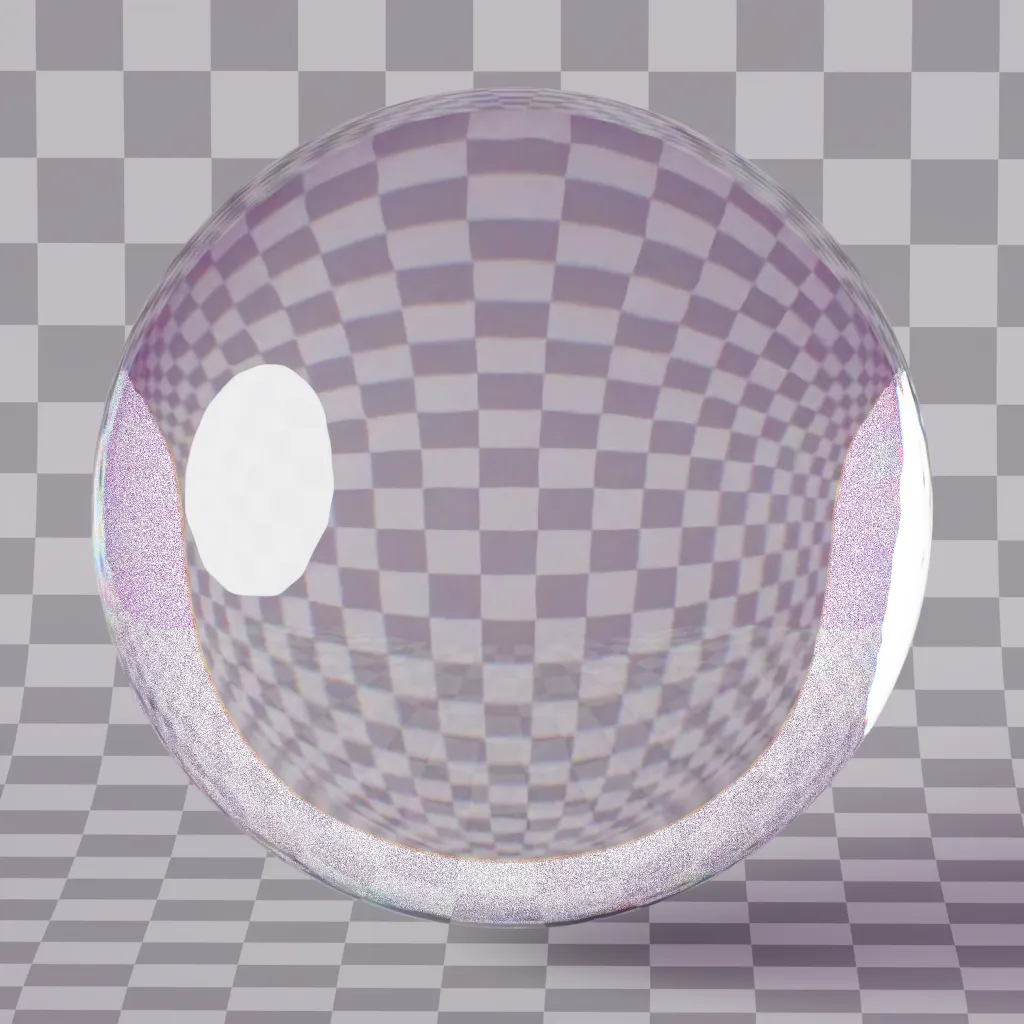
Get this materialPhysically-modeled cubic zirconia (yttria-stabilized ZrO2, the most widely used diamond simulant) dispersion, built from the real three-term Sellmeier equation of Wood & Nassau, Appl. Opt. 21, 2978 (1982), for the industry-standard 12.0 mol% Y2O3 stabilization: n^2 = 1 + 1.347091lam^2/(lam^2-0.062543^2) + 2.117788lam^2/(lam^2-0.166739^2) + 9.452943*lam^2/(lam^2-24.320570^2), lam in um - not tuned by eye. At the sodium D line (589.3nm) this gives n=2.15846, matching the source paper's own cited value (n_D=2.15847) to 5 significant figures, and the computed F-C dispersion (0.03456) matches the paper's own cited 0.03455 the same way. Per-channel refractive indices used here: R 2.15208 @630nm, G 2.17024 @532nm, B 2.19060 @465nm. The real, checkable, counter-intuitive fact: cubic zirconia disperses light MORE than diamond does (about 1.38x this creator's own diamond asset's F-C dispersion) - a well-cut CZ often throws MORE rainbow fire than a diamond of the same cut, despite being the cheaper stone, which is the actual optical reason jewelers can often tell the two apart by eye. Less dispersive than this creator's moissanite asset, more dispersive than the sapphire or N-BK7/N-SF11 glass assets in the same series. Channel tint colors are the CIE 1931 color-matching function's actual response at each sampled wavelength. Uses the standard three-IOR additive-Glass-BSDF technique for Cycles/Eevee. Apply to any faceted gem-cut mesh - this asset ships the material only, not geometry. Same CIE 1931 code already shipped and tested in this creator's Caustify spectral path tracer and the N-BK7/N-SF11/diamond/moissanite/sapphire materials.


